.png)
Winning the Digital Court: How Courtclean Turned 30 Years of Offline Trust Into a Predictable Digital Growth Engine
Updated: Apr 7
By Jordan Dawson | jrdndwsn.com Digital Strategy · SEO/GEO · Case Study

The Brand You Already Knew — Just Not Online
Some brands earn their reputation the hard way. They don’t rely on ads or viral moments. Instead, they build trust over decades by consistently delivering quality. Courtclean is one of those brands.

Founded in 1992, Courtclean built its name through word of mouth. Coaches and athletic directors spread the word about Courtclean on hardwood floors across the country. From high school gymnasiums to NBA arenas, if you cared about the safety and performance of your court, you used Courtclean. Full stop.
But here’s the thing about offline reputations: they don’t automatically follow you online. When I began working with Courtclean, I faced a 30-year legacy brand that had earned immense trust. Yet, its digital presence struggled to tell that story effectively.
The Disconnect: A Legacy Brand Stuck in Catalog Mode
The Courtclean website was functional. It listed products and prices. But it wasn’t working hard enough. The site felt like a flat catalog. It had scattered product pages with no unified narrative, technical specs written for engineers rather than coaches, and zero guided paths from the moment a visitor landed to when they felt confident enough to buy.

Here’s what the digital presence was missing:
A unified brand story. Courtclean's 30-year history, family-owned roots, and proven performance were buried in footers and "About Us" pages that nobody reads.
Outcome-driven messaging. The copy led with specs—dimensions, materials, weight—rather than the results that coaches and athletic directors truly care about: safer floors, faster cleanups, and game-ready courts.
A clear product ecosystem. The damp mop, the sweat mop, the cleaners, and the towels all existed on the site as isolated items instead of one complete, unified system.
Search authority. There was no content strategy capturing high-intent searches from coaches, gym managers, and ADs actively looking for solutions.
The product led the category on the court, but the website was not leading anything online.
The New Rules of Search — And Why They Changed Everything
While we diagnosed the Courtclean website, the broader search landscape underwent one of its biggest shifts in years. AI answer engines—think Google's AI Overviews, ChatGPT, Perplexity, and others—started summarizing results directly for users before they clicked a single link. Organic click-through rates for informational searches dropped by an estimated 30 to 45 percent almost overnight.
The old playbook of "rank for keywords and wait for clicks" was officially broken. The new game is Generative Engine Optimization (GEO). This practice positions your brand not just to rank, but to be cited by AI answer engines as the trusted authority on a given topic.
For Courtclean, this meant one thing: zero clicks do not equal zero value. If an AI engine summarizes "how to clean a hardwood basketball court" and recommends Courtclean by name, that mention carries more weight than a #3 ranking ever did. The goal shifted from ranking to being recommended.
The Strategy: Three Moves That Changed Everything
Once I understood the brand, the gap, and the new search environment, the strategy came together around three core moves.
1. Clarify Audience Intent
Courtclean sells to a specific group of people: coaches, athletic directors, and gym facility managers. These busy professionals are not shopping casually; they are searching with intent. The first move was rewriting every page around what those buyers actually care about: safety, speed, consistency, and budget-friendly maintenance. Not materials. Not dimensions. Outcomes.
2. Build a Content Hierarchy
The second move involved organizing the site around high-intent themes rather than just products. Topics like gym floor maintenance, basketball court cleaning, and damp mop vs. dust mop performance became the organizing framework. Every product and educational page was mapped to a search theme. This way, Courtclean's expertise showed up exactly where buyers were looking—on Google, AI answer engines, and anywhere else decisions were being made.
3. Unify the Ecosystem
The third move was the most visible to site visitors. We stopped treating Courtclean's product line as a loose collection of items and started presenting it as one complete system. The 6' Damp Mop, the 18x24 KeyClean Sweat Mop, the Super Shine-All Cleaners, and the custom terry cloth towels—all of it now told a single story. A coach or facility manager visiting the site could immediately see the path from a dirty, hazardous floor to a squeaky clean, game-ready surface. No guesswork. No bouncing between disconnected pages.
Elevating the Brand Origin Story
One of the most impactful changes we made had nothing to do with keywords or technical SEO. It was simpler than that. We moved the brand story to the front page. For years, Courtclean's family-owned origin, 30-year history, and adoption by NBA arenas were treated like background information—footnotes, basically. We made it the headline.
Why does this matter? When someone discovers a brand for the first time through a search engine or an AI summary, they need to immediately feel that this brand has credentials. They need to trust it before they buy it. Leading with "Founded in 1992. Trusted by NBA arenas and universities nationwide. Family-owned and performance-driven." does more conversion work in five seconds than any product spec can do in five minutes.
Building a Flawless Technical Foundation
A great story only works if search engines and AI answer engines can actually read it. After overhauling the narrative and messaging, we went under the hood and removed every technical barrier standing between Courtclean's content and the algorithms evaluating it:
Aligned all title tags, meta descriptions, and headings with the new outcome-driven narrative.
Rebuilt internal linking to establish semantic authority across the full product and content ecosystem.
Validated meta, canonical tags, hreflang, and crawlability across the entire site.
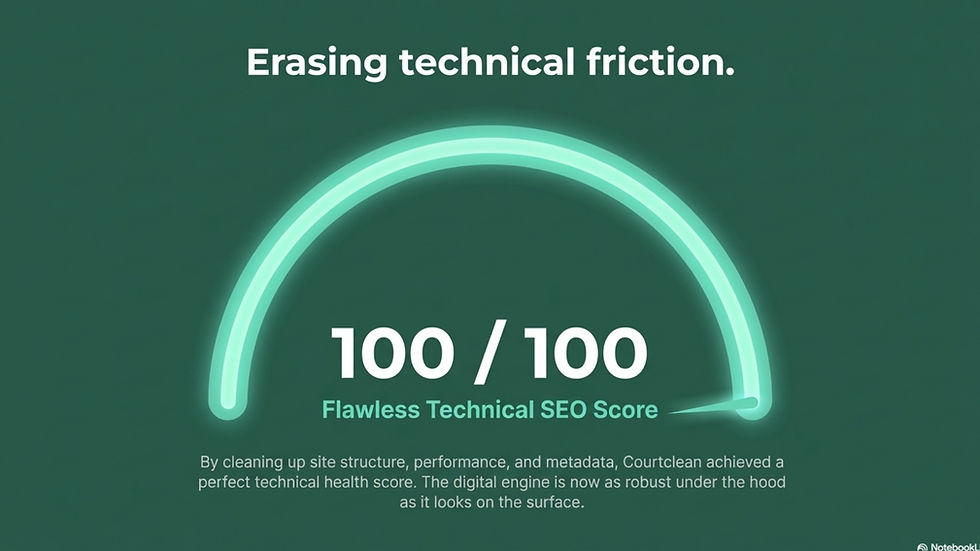
The result? The Courtclean homepage achieved a perfect 100/100 technical SEO score on Google-aligned checks. Every future piece of content is now built on a frictionless, AI-ready foundation.
What This Means for Product-Strong Brands
Courtclean's story is not unique. It represents a common challenge I see with established brands. They have a world-class product, a loyal customer base, and real credibility earned over years or decades. Yet, their digital presence fails to communicate any of it.
The gap between offline reputation and online presence is not a product problem. It is a strategy and storytelling problem. And it is 100 percent fixable. Here’s what the Courtclean transformation proves:
Reputation is an asset, but only if you activate it. A 30-year history means nothing online if it is buried in the footer.
Buyers buy outcomes, not specs. Translate what your product does into what your customer feels.
GEO is not optional anymore. If AI answer engines are not citing your brand, you are invisible to a growing percentage of your market.
Technical health enables everything else. A great story on a broken foundation is still broken.
Loyalty is the real metric. Getting someone to come back is harder than getting them to come the first time—and far more valuable.
Ready to Win Your Digital Court?
Courtclean's digital presence finally matches what coaches have known for decades—it is the standard, not an alternative. If you're running a product-strong brand with an underperforming digital presence, this is exactly the work I do.
Stop relying on scattered marketing and word-of-mouth to carry your online growth. Lean into AI, build your digital authority, and get results that show up in your revenue—not just your vanity dashboards.
[Schedule a Free Site Audit & Consultation at jrdndwsn.com]
Jordan Dawson is a digital strategist and SEO/GEO consultant based in Las Vegas, Nevada. He helps product-strong brands translate their offline reputation into predictable digital growth engines. Learn more at *jrdndwsn.com


Comments